

In this post, we’ll unpack all you need to know about the book Pattern Breakers and Inflection Theory, including what it’s about, who it’s for, a breakdown of the core framework and more.
What Is Pattern Breakers?
Pattern Breakers is a book by authors Mike Maples Jr. and Peter Ziebelman that unpacks the hidden forces behind business outliers through a framework known as Inflection Theory.
Who Is Pattern Breakers For?
Pattern Breakers is a practical playbook for founders and executives who want to build an outlier company and investors who want to back them.
The Central Problem: Pattern Matching Is A Trap
Human brains are wired to recognise patterns. It is one of our most powerful cognitive assets. However, in business and entrepreneurship, that same instinct can become a liability.
Established companies optimise existing patterns. The result is an entire ecosystem of thinking designed to defend the existing paradigm rather than creating a new one.
The founders who change the world do not follow patterns. They break them.
Because their ideas and actions are so radical, pattern breakers tend to face serious resistance from individuals and institutions. However, driven by a deeper purpose, they forge ahead.
“The people who are crazy enough to think they can change the world are the ones who do.” — Steve Jobs
Inflection Theory: The Core Framework
Inflection Theory holds that every outlier success — referred to as a Pattern Breaker — is built on a four-part causal sequence: an inflection, an insight, an idea and a movement.
This sequence is ordered for a reason. If you weaken any link, the chain collapses. Therefore, every startup failure can be traced back to where the sequence breaks.
1. Inflections
An inflection is an event that creates the potential for radical change in how people think, feel and act.
There are 3 types of inflections: technological, regulatory and societal. All 3 often reinforce one another.
An idea passes the inflection test if it is an external event that drives radical change in how people think, feel and act and empowers people to do something that was impossible to do before.
Checklist
- Identify The Inflection: What specific external event — technological, regulatory or societal — is creating the potential conditions for radical change right now?
- Test The power: Does the inflection empower people to do something that was impossible to do before and if so, how many people and how significantly?
- Why Now: Why is the opportunity available at this moment and what would have made the idea impossible in the past?
- Convergence: Are multiple inflections converging?
2. Insights
An insight is a non-consensus truth about how one or more inflections can be harnessed to radically change how people think, feel and act.
Insights require Living In The Future which is the practice of immersing oneself so deeply in an emerging domain that you form “valid opinions” about a world most people haven’t experienced yet.
An idea passes the insight test if it non-consensus, true, rejected or ignored and radically changes how people think, feel and act.
Checklist
- Non-consensus Test: Is the insight non-consensus and still widely rejected or ignored?
- Non-obvious Test: Does the insight come from genuine immersion?
- Behaviour Change: Does the insight radically change how people think, feel and act?
- Living In The Future: Are you immersed deep enough inside the domain to see what other people can’t?
- Earned Secrets: What do you know that you could only have learned through direct, obsessive immersion and not research or analysis?
- Check: What signals would suggest you were right and what signals would suggest you were wrong?
3. Ideas
An idea is the concrete product or service that directly expresses the underlying insight.
The idea needs to exist because of the insight, not alongside it.
The best strategy to create a breakthrough is to avoid competing with incumbents who define the existing game and set of rules and instead create an entirely new game and set of rules.
An idea passes the idea test if it is inseparable from the insight, produces strong reactions in both directions, the story positions the customer as the hero and the company as the guide who enables their transformation and forces a choice.
Checklist
- Polarisation Test: Does the idea produce strong reactions in both directions?
- Hero’s Journey: Does the story position the customer as the hero and the company as the guide who enables their transformation?
- Forces A Choice, Not A Comparison: Does the idea create a new category and force a choice?
4. Movement
A Movement is the community of believers — customers, employees and investors — who carry the idea before the world catches up.
A Movement is what turns an idea into a cause and influences people to adopt a new way of thinking, feeling and acting.
The same way ideas are hard to formulate, movements are hard to initiate because incumbents do everything they can to maintain the status quo.
As movements expand, their impact shifts from influencing the minority to influencing the majority. What was once rejected is now accepted as the norm.
Effective movements require bold and decisive leadership and powerful and provocative storytelling that energises and motivates people to champion the cause by defining a larger purpose.
The way to craft a persuasive story is to:
- Appeal To A Higher Purpose
- Attack The Status Quo
- Create A Hero’s Narrative
- Force A Choice, Not A Comparison
- Define Your Breakthrough Language
The best way to attack the status quo is to position it as an enemy and frame its greatest strengths as its greatest weaknesses. It must describe the status quo’s problems by contrasting the existing world with the new world which compels people to never accept the status quo again.
Differences in language create differences in how people think, feel and act.
An idea passes the movement test if it turns people into believers, if the founder’s skills, obsessions and network align with the specific future they are trying to build, if the founder is disagreeable and if the founder can clearly and concisely articulate the future they are trying to create.
- Founder-future Fit: Does the founder’s skills, obsessions and network align with the specific future they are trying to build?
- Disagreeableness: Is the founder prepared to be disagreeable when customers, investors or advisors push them toward consensus?
- Pre-vision Clarity: Can the founder clearly and concisely articulate the future they are trying to create?
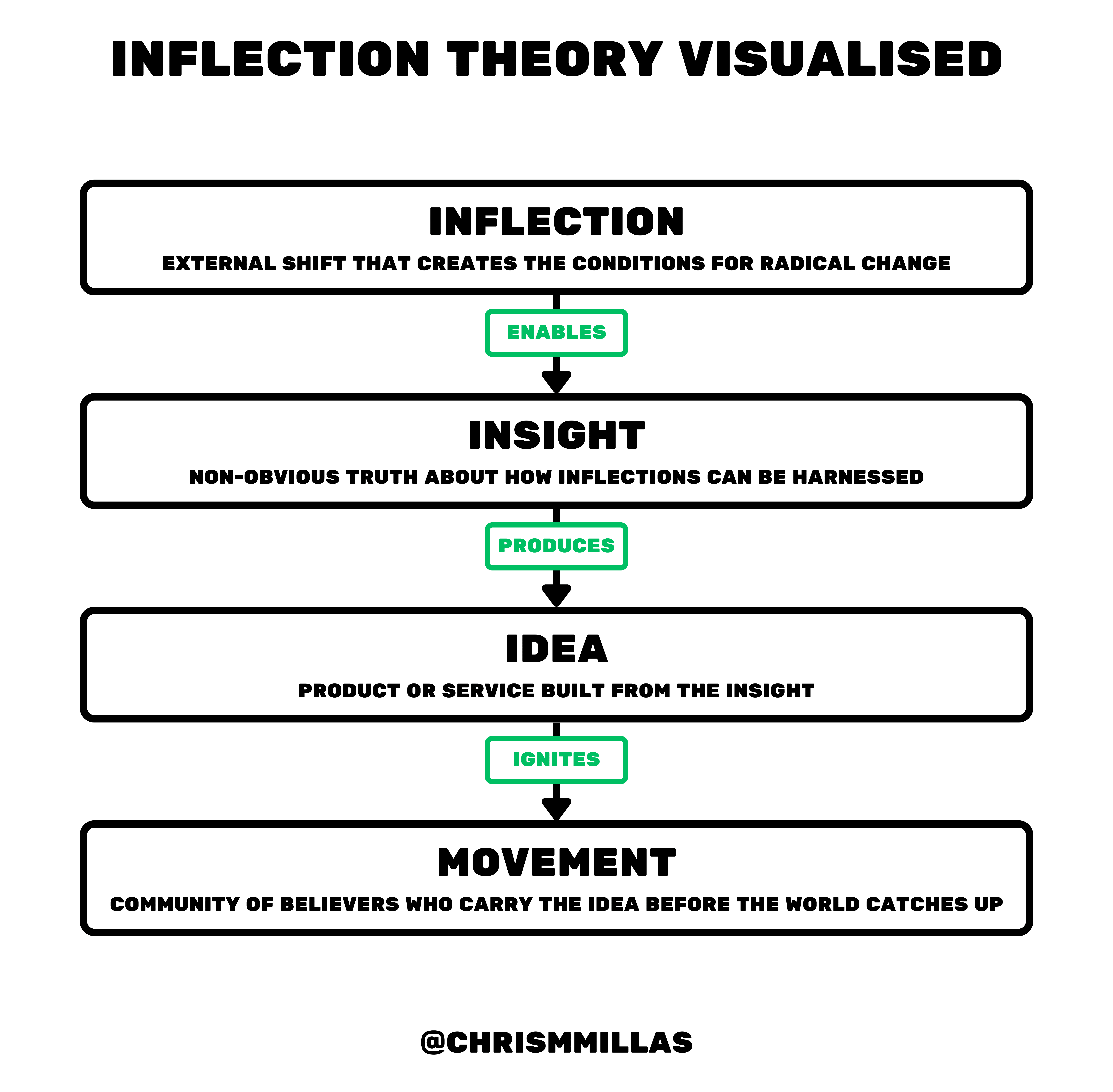
Table Summary: Pattern Matchers Versus Pattern Breakers
Pattern Matchers look backward, act on precedent, avoid uncertainty, pursue consensus, and compete within existing paradigms.
Pattern Breakers look forward, act on inflections, embrace uncertainty, pursue non-consensus and create new paradigms.
This distinction sits at the heart of Inflection Theory and how breakthrough companies do not win by fitting into the existing pattern, but by creating a new one.
| Dimension | Pattern Matchers | Pattern Breakers |
| Orientation | Look backward | Look forward |
| Basis For Action | Act On Precedent | Act On Inflections |
| Relationship To Uncertainty | Avoid Uncertainty | Embrace Uncertainty |
| Social Posture | Pursue consensus | Pursue Non-consensus |
| Competitive Posture | Compete Within Existing Paradigms | Create New Paradigms |
Real-World Application: Uber
Uber is a clear real-world example of a Pattern Breaker. It shows how a company can look strange in the present yet inevitable in hindsight. Mapped against Inflection Theory, Uber illustrates exactly how inflections, insights, ideas and movements come together to create a breakout company.
The inflections were smartphones, GPS and mobile payments. The insight was that mobile phones could become the interface for transportation and make hailing a ride feel as simple as pressing a button. The idea was not “a better taxi company” but a software-native transportation network. The movement was from early believers who immediately felt that the old way of getting a ride now seemed broken.
Summary (TL;DR)
Pattern Breakers is a book by Mike Maples Jr. and Peter Ziebelman that explores the hidden forces behind business outliers through a framework called Inflection Theory.
Inflection Theory holds that breakout companies are not accidental. Instead, they follow a causal sequence: an inflection creates the potential for an insight, the insight produces an idea and the idea becomes a movement.
Pattern Breakers is a practical playbook for founders who want to build an outlier company, investors who want to back them and strategists who want to identify and respond to disruption before it arrives.
The framework gives you a practical way to evaluate an idea, thesis or company at each stage in sequence, so you can identify where the chain breaks and why an opportunity may fail to become a breakout success.