

In this post, we’ll unpack all you need to know about the book The Cold Start Problem, including what it’s about, who it’s for, a breakdown of the core framework, key takeaways and more.
What Is The Cold Start Problem?
The Cold Start Problem is a book by Andrew Chen that explores how companies build and sustain network effects.
The book answers a fundamental question: How do you build something from nothing when your product only works if other people are already using it?
Who Is The Cold Start Problem For?
The Cold Start Problem is a practical playbook for founders who want to launch and scale a networked product, investors who want to evaluate network effect businesses and operators who want to defend and extend a network once it exists.
The Central Problem: Zero Is The Hardest Number
Network effects are widely recognised as the most powerful force in technology. A successful network effect requires a product and a network. The product is typically made of software and the network is typically made of users.
A product with strong network effects becomes faster, stickier and harder to displace with every new user.
However, network effects only work once a network exists. Before that, the same dynamic that makes a product almost impossible to stop at scale makes it nearly impossible to start at launch.
This is the cold start problem and every networked product must solve it before it can benefit from it.
Network effects are nothing at the start and everything at scale.
The Core Framework: The 5 Stages
The Cold Start Problem is built around a 5-stage lifecycle that every networked product passes through. Each stage presents a different challenge and demands a different strategy.
The stages are: the Cold Start Problem, the Tipping Point, Escape Velocity, Hitting The Ceiling and The Moat.
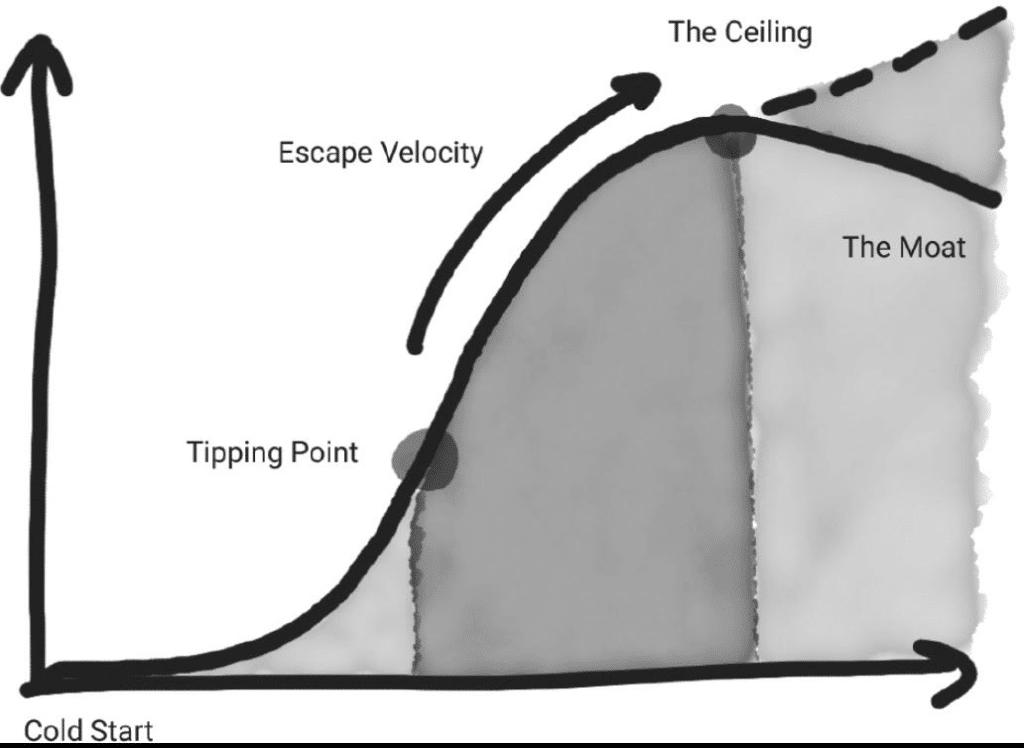
The sequence matters because strategies that work at Stage 1 fail at Stage 3.
Stage 1: The Cold Start Problem
The Cold Start Problem is the challenge of making a product valuable enough for the first users to join when no network yet exists.
The solution is to build an atomic network. This refers to the smallest possible group of users that can sustain the network on its own. This is the minimum viable version of the network and it must be both dense enough and complete enough to deliver real value before growth begins.
The next big thing will start out looking like it’s for a niche network.
If you can create one stable, engaged and self-sustainable network — an atomic network — then you can likely build a second network adjacent to the first one. And if you can build a second, then you can likely build enough to build a huge interconnected network that spans the entire market.
Every networked product has two types of users: the hard side and the easy side.
The hard side is the group whose participation is difficult to attract but whose presence makes the product valuable for everyone else. The easy side is the group whose participation is easy to attract but whose presence only shows up once that value exists.
The easy side follows once the hard side is in place.
Solving the cold start problem means solving for the hard side first. Everything else is a consequence of that.
Stage 2: The Tipping Point
The Tipping Point is the moment at which a network reaches critical mass and begins to grow on its own.
Before the tipping point, growth requires constant manual effort. After it, the network starts to pull in new users without the same level of intervention. The goal of this stage is to replicate the atomic network by building more of them in more places until the network tips at scale.
Different products tip differently. The strategic task is to understand the shape of the tipping point for the specific network and concentrate resources there.
As a network grows, each new network starts to tip faster and faster, so that the entire market is more easily captures.
Stage 3: Escape Velocity
Escape Velocity is the stage at which the network generates enough self-sustaining momentum to drive compounding growth.
Andrew Chen identifies 3 growth flywheels that compound on each other when a network reaches this stage.
Firstly, the Acquisition Flywheel, where existing users invite new users, reducing the cost of growth over time.
Secondly, the Engagement Flywheel, where more users generate more content, activity and interaction, which pulls existing users back more frequently.
Thirdly, the Economic Flywheel, where scale improves unit economics, which funds further investment in product and growth.
These flywheels are mutually reinforcing. Companies that reach escape velocity grow faster, retain better and become cheaper to operate — all at the same time.
Stage 4: Hitting The Ceiling
Hitting The Ceiling is the stage at which growth slows, churn increases and the network faces natural limits on how far it can expand.
Every network eventually hits a ceiling. The causes are structural: the most valuable users have already joined, acquisition costs rise as easy markets saturate and product quality can erode as the network becomes too large or too noisy.
The most common ceilings are overcrowding (too much content or noise), commoditisation (the product becomes generic) and multi-tenanting (users switch between competing networks). Each requires a different response.
A recurring problem for networked products is that momentum eventually slows and everyone declares the product over. However, if management can hold it together and continue shipping new features to counter the slowdown, they often pull through.
Stage 5: The Moat
The Moat is the defensive strength that strong network effects create against competition.
A network with genuine moat strength becomes self-defending. New entrants face the same cold start problem the incumbent once solved, but now must solve it against an entrenched competitor with greater scale, superior data and stronger relationships.
However, the moat is not permanent. It degrades if the network stops growing, stops improving or stops protecting the hard side. The companies that maintain their moat treat it as something to be actively defended — through product investment, hard-side retention and continuous network deepening — rather than a static asset.
Summary (TL;DR)
The Cold Start Problem is a book by Andrew Chen that maps the full lifecycle of a networked product through a 5-stage framework: The Cold Start Problem, Tipping Point, Escape Velocity, Hitting the Ceiling and The Moat.
The same dynamic that makes a networked product nearly impossible to stop at scale makes it nearly impossible to start at launch. Every networked product must solve the cold start problem before it can benefit from it.
Therefore, the companies that win are those that solve each stage in sequence: seeding the atomic network, tipping into critical mass, compounding through the 3 flywheels, breaking through the ceiling and defending the moat.