

In this post, we’ll unpack all you need to know about the book Play Bigger, including what it’s about, who it’s for, a breakdown of the core framework and more.
What Is Play Bigger?
Play Bigger is a book by Al Ramadan, Dave Peterson, Christopher Lochhead and Kevin Maney that argues how the most valuable companies do not compete in existing markets but create, define and dominate entirely new market categories.
Who Is Play Bigger For?
Play Bigger is a practical playbook for founders and executives who want to build a Category King and investors who want to back them.
The Central Idea: Category Kings Capture Most Of The Value
The authors studied hundreds of public technology companies and found a consistent pattern.
In any given category, one company tends to capture a disproportionate share of the total market capitalisation — roughly 76%. The rest fight over what remains. This is the economic prize for becoming a Category King.
The category winner walks away with a major majority of the categories economics
A Category King is the company that creates, defines and ultimately dominates a category. It does not simply sell a product. It defines the problem the market should care about, positions itself as the obvious solution and conditions customers, investors and the media to think inside its own frame. By the time competitors arrive, the King already owns the mental real estate.
This is why most companies struggle. They get trapped inside existing categories. When that happens, customers compare them to incumbents, investors misunderstand them and the market forces them to play by someone else’s rules.
Category Kings escape this trap by creating a new category, defining the language around it and dominating the market that forms around it.
The ability to set the rules of a new category is the ultimate power play in business. If you’re not writing the rules, you’re playing by someone else’s rules.
Category Kings are not always the first movers. They are the companies that define the problem best, move the fastest and own the category narrative before anyone else.
Google was not the first search engine. Salesforce was not the first CRM. Uber was not the first on-demand service. Each became a Category King by redesigning the category frame.
Creating a category that demands a product works better than creating a product that hopefully generates demand.
The Category Lifecycle
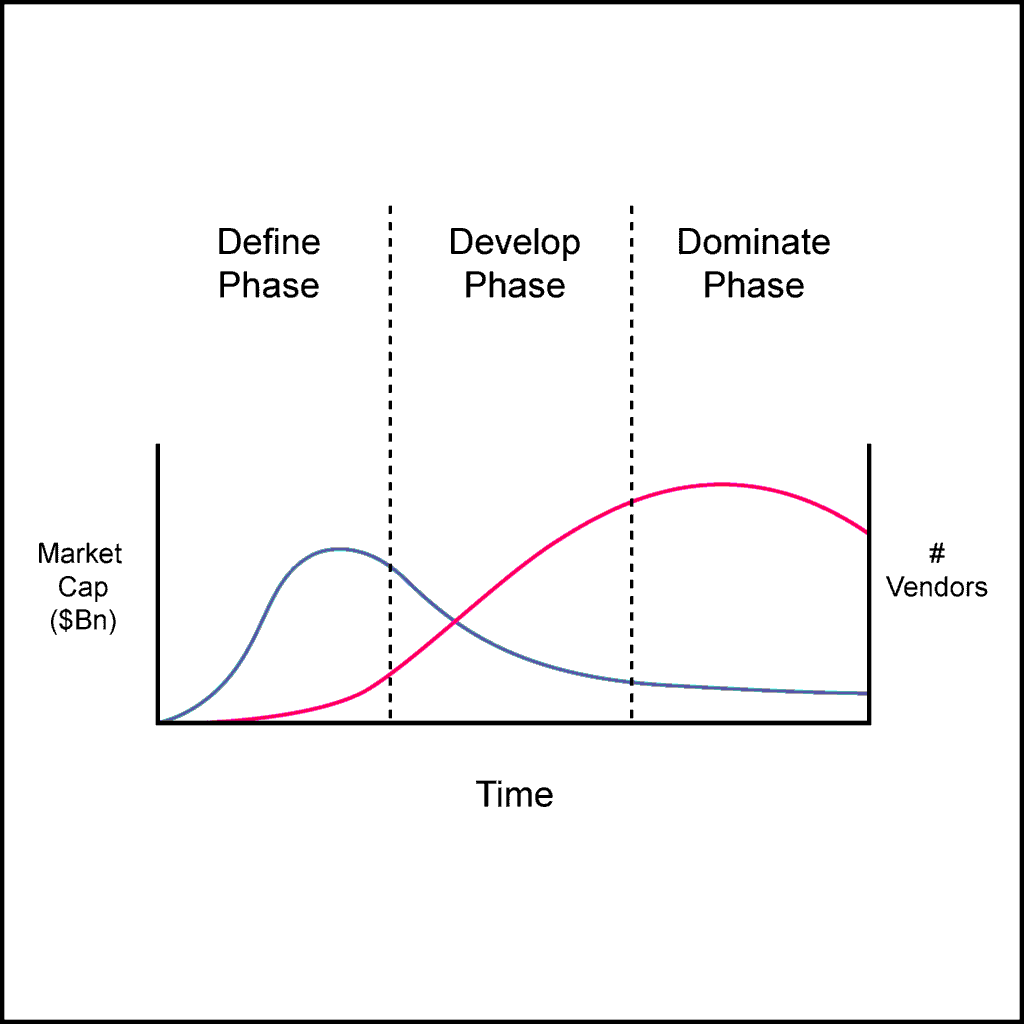
The Category Lifecycle model tracks how markets evolve through three stages: define, develop and dominate.
Define is about identifying the problem, naming the category and creating the frame through which the market understands the opportunity. The company that defines the space is best positioned to dominate it. During this stage, total category value grows slowly as the market finds its footing and the number of competitors is still high.
Develop is about educating the market, building the ecosystem and driving adoption until the category starts to take shape. During this stage, value accelerates sharply as the category catches on and the number of vendors falls and one clear King begins to emerge.
Dominate is about becoming the default leader of the category and capturing the majority of its economic value. During this stage, value peaks and tapers as the category matures.
The critical moment is when the number of vendors and total category value cross: vendors declining and value rising. That crossing point is when the King tends to be crowned. Before it, the category is still contestable. After it, the winner becomes almost impossible to catch.
The data behind Play Bigger shows that most categories are won or lost within the first six years of formation and category Kings are typically crowned around year six.
This is why speed matters. Category Kings are not necessarily crowned by having the best product. They are crowned by moving fastest to own the frame in customers’ minds.
It takes time for people to change their buying behaviour because psychologically, the market can only absorb a new problem and a new solution at a certain speed. The bigger the problem, the longer that shift usually takes.
This is why a company’s most important job is to align its entire organisation around one goal: changing how people think, feel and act.
The Category Design Framework: The Magic Triangle
The authors organise their framework around the concept that a successful business must design three things simultaneously: the category, the product and the company.
If all 3 elements are working in sync, they reinforce each other and create a compounding effect on the company and the market.
1. Category Design
Category Design is the deliberate practice of defining a new problem and positioning your company as the only solution that makes sense.
Most companies think about building a product first, positioning second and category third. This sequencing is fatal. By the time the company turns its attention to Category Design, a competitor has already planted the flag.
Category Kings do the opposite. They start by identifying a problem first and then design the category, product and company around solving that problem.
When a company deeply understands the customer’s problem, it triggers the release of oxytocin which builds trust and makes them more receptive to its way of thinking.
The company that best frames both the problem and the solution is the company that tends to define the category.
By definition, category design means stepping out into the unknown. It requires absolute belief in a category that others can’t yet see. Leaders will face serious resistance from individuals and institutions but they have to have the courage to forge ahead.
Discovering the category is hard to get right and costly to get wrong. However, naming the category is act of power. The company that names the category controls the category.
Point Of View (POV)
A Point of View is the founder’s manifesto and a declaration that the world has a problem worth solving and that a new category must exist to solve it.
The POV answers three questions: What is broken about the world? What does the future look like if we fix it? Why is this company the one to lead that change?
The purpose is to clearly and emotionally define the problem and the solution to problem and to create a space in people’s minds for a new category that your product can fulfil.
A strong POV describes the problem and makes the problem feel so real and so urgent that the audience cannot go back to accepting the status quo. It forces a choice not a comparison.
The Lightning Strike
A Lightning Strike is a concentrated, high-impact event designed to introduce the category and the Category King simultaneously to the world.
Lightning Strikes are deliberately orchestrated moments — a keynote, a major product launch, a data release, a media campaign — that generate maximum attention in a compressed window of time.
Lightning Strikes are category announcements, not product announcements. They are company events, not marketing events.
A Lightning Strike demonstrates that the category is real, the vision is inevitable and the company has the product and strategy to lead it. It tells the market that this company knows how to define the problem and solve it.
The goal is to implant the category frame into as many minds as possible — customers, analysts, investors — in a single concentrated moment.
A successful Lightning Strike forces competitors to position themselves relative to the King’s definition of the space. The King sets the frame. Everyone else responds to it.
When done right, the cost of acquiring new customers falls for the Category King and rises for every competitor that follows.
2. Product Design
Product design is the deliberate practice of building the product that makes the category real.
The product must prove the company’s Point Of View. It must show customers that the problem is real, the old way is broken and the new category is the obvious solution.
3. Company Design
Company design is the deliberate practice of aligning the entire organisation around the category.
This means the company’s culture, strategy, hiring, sales, marketing, incentives and internal language all have to reinforce the same category vision.
The Category King Flywheel
Once a company’s Category Design takes hold, a flywheel effect kicks in. This self-reinforcing loop allows market leaders to pull further ahead in several ways:
- Cognitive Biases: Human psychology, such as the anchoring effect, conformity bias, choice-supportive bias and groupthink, compels buyers to flock to the established King.
- Capital: Kings attract disproportionate investment, commanding premium valuations that fund R&D, acquisitions and talent at a scale challengers simply cannot match.
- Knowledge & Experience: Every customer won, every deal lost and every product iteration compounds into institutional knowledge that followers are years behind replicating.
- Data Advantage: Kings gain a continuous influx of user data, enabling them to anticipate market trends and improve their product faster than followers.
- Ecosystem Gravity: Top talent, the best investors, partners and media coverage are inherently drawn to the winner.
As the category grows, the King gets stronger. As the King gets stronger, the category grows faster. This is the compounding loop that makes Category Kings so hard to displace.
Category King Forces
Category Kings are the result of specific forces that completely separate one company from the rest.
They define the category name and establish the vocabulary that the entire industry inevitably adopts.
They condition buyers on how to think about the problem before selling the solution.
Additionally, they continuously release data and research that controls the narrative and frames the category on their terms.
They build ecosystems of partners, developers and customers whose success is tied to their continued dominance.
They become deeply embedded inside enterprise infrastructure that makes it almost impossible to displace them.
Real-World Example: Uber
Uber did not simply build a better taxi company. It reframed the market around a new idea: transport should be instant, app-based, cashless and available on demand.
Before Uber, customers thought in terms of taxis. After Uber, they thought in terms of pressing a button and getting a ride. That shift created a new category: ridesharing.
Uber became the Category King because it defined the problem, made the old taxi model feel outdated and trained the market to associate on-demand transport with Uber.
Summary (TL;DR)
Play Bigger argues the greatest companies do not compete inside existing markets but instead create, define and dominate entirely new market categories. These companies become Category Kings.
A Category King must design three things at once: the category, the product and the company. The category must define the problem. The product must solve the problem. The company must organise itself around the problem.
Category Kings win because they shape how the market thinks before competitors can shape how the market compares. The company that defines the problem, names the category and becomes the default solution captures the majority of the value.
Play Bigger is a practical playbook for founders and executives who want to build a Category King and investors who want to back them.